

10 things every estimator needs to know about concrete

Bloster
TLDR
Concrete estimating involves far more than volume calculations. Site access, weather, curing, finishing, testing, safety requirements, and disposal all affect cost and must be built into accurate estimates.
What makes concrete estimating so complex
Working as an estimator means learning about construction methods and materials, understanding how to calculate different types of construction, and usually keeping a binder full of cheat sheets and formulas close at hand.
Even if you use the best construction estimating software, you still need to understand what goes into every item and assembly to price work accurately. In this article, we look at the key factors that affect concrete costs and how to account for them properly in your estimates.
1. Site access affects concrete pouring options
It is easy to assume that calculating concrete costs only requires working out volume and calling the nearest ready mix supplier. In reality, site access can change everything.
If concrete trucks cannot get close enough to pour directly from the chute, you may need to use a pump or move concrete by wheelbarrow. Each option significantly impacts labour and equipment costs, which must be reflected in your estimate. Always assess site access before pricing concrete work.
2. Concrete shrinks as it cures
Drying and curing are two different processes. While concrete may appear dry quickly, the curing process continues for weeks.
During curing, concrete shrinks slightly. To avoid shortages, estimators should always include waste in their calculations. Adding five to ten percent is usually sufficient to cover shrinkage and on site losses, whether you estimate manually or using construction estimating software.
3. Ready mix suppliers charge standing time
Ready mix pricing usually includes both the cost of concrete and standing time. Standing time is charged for every minute the truck is on site, even if concrete is not being poured.
Delays can quickly add hundreds of dollars to a pour. Concrete should only be ordered when the site is fully prepared, and clients should be informed that delays may result in additional charges.
4. Concrete requires special PPE
Concrete is highly alkaline and can cause serious chemical burns on contact with skin.
Any estimate that includes concrete work should allow for appropriate PPE such as gloves, boots, goggles, and protective clothing. Training costs for workers handling concrete safely should also be included in labour rates within your estimating system.
5. Cold weather may require heating and hoarding
Concrete relies on moisture to cure properly. In cold conditions, water within the mix can freeze before curing is complete, permanently weakening the concrete.
To prevent this, heating and hoarding may be required to maintain temperature during curing. These methods can be expensive, so winter pours should always include these additional costs in your estimate.
6. Water quality and contaminants matter
Concrete curing is a chemical reaction that depends on precise mix conditions. Contaminants such as sugar or unsuitable water can slow or stop the curing process entirely.
Hard and soft water can also impact strength results. If mix quality cannot be reliably controlled on site, the safer option is to price ready mix concrete rather than site mixing.
7. Air bubbles weaken concrete
Air pockets trapped in concrete during placement reduce strength and durability.
To prevent this, vibrating equipment or concrete pokers are used to remove trapped air. Estimators must account for the cost of equipment and additional labour required to achieve proper compaction.
8. Concrete is extremely heavy
Concrete demolition and removal is often more expensive than expected. A cubic metre of concrete weighs approximately 2.4 metric tons.
Once broken up, concrete also increases in volume, meaning fewer loads can be transported per trip. Disposal, transport, and dump fees must be carefully calculated and included when estimating demolition work.
9. Finishing is part of the cost
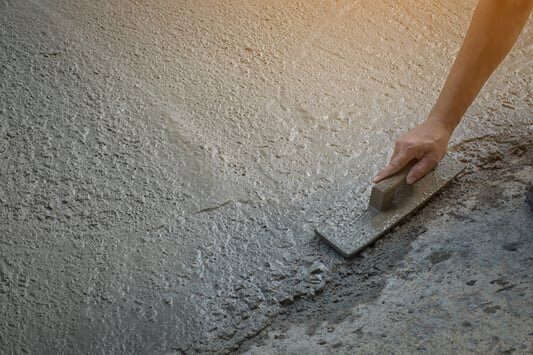
Pouring concrete is only one stage of the job. Finishing methods such as broom finishes, float finishes, or stamped concrete all require additional labour and equipment.
Estimators must confirm finish requirements early and build the correct finishing costs into the quote.
10. Concrete testing is costly
Many projects require slump tests, cube tests, or other compliance testing to confirm concrete strength.
These tests are usually required per pour and can add up quickly. Always confirm testing requirements in advance and include testing costs for every truckload of concrete in your estimate.
You do not have to reinvent the wheel for every quote
Manual estimating and spreadsheet based systems require estimators to remember every small detail for every job. This increases both workload and risk of errors.
Modern construction estimating software like Bolster allows estimators to build assemblies that include labour, equipment, materials, waste, and risk factors. Once created, these assemblies can be reused and refined over time.
Bolster goes even further by capturing up to date supplier pricing automatically, helping ensure estimates remain accurate in a constantly changing market.
If concrete estimating is slowing you down or introducing risk into your quotes, the right technology can make a measurable difference in speed, accuracy, and profitability.